Derailleur Hanger Compatibility Chart by Bike Brand & Model
Use a derailleur hanger compatibility chart to match your bike’s brand, model, exact year, OEM/dropout part number, axle standard, and mounting-bolt orientation. Don’t choose by silhouette alone: verify Side A/Side B offset, plate thickness, and direct-mount versus standard interface. Confirm QR or 12 mm thru-axle fitment; Trek Procaliber may use Hanger 453, while 2021–22 Merida Scultura 6000 lists Hanger 697. Inspect carbon damage and verify UDH revisions first. The checks below help you confirm fit.
Match Mounting Bolt Orientation
Before you use a derailleur hanger compatibility chart, match the mounting bolt orientation to your original hanger: confirm the bolt hole’s left/right placement, its angle, and the hanger’s rotational position against the dropout. Treat orientation as a mechanical datum.
Trek through-axle, Merida road, and Kona bolt-on dropouts can place the retaining thread on different sides or clock hangers differently. Compare the mounting face, threaded-hole offset, and bolt axis with the removed part.
Don’t choose a match because its silhouette looks identical; millimeters of offset can skew derailleur alignment, disrupt indexing, and cause frame contact. Photograph both faces in light, showing holes, threads, and dropout interface.
If the chart doesn’t show orientation clearly, submit images through its identification request. You’ll confirm geometry before ordering.
Brand-Model Hanger Cross-Reference
Use a brand-model cross-reference to narrow the search, then confirm the exact model year and hanger part number against the removed component. Treat the OEM number, visual outline, and fastener pattern as a combined identifier; a shared brand name doesn’t establish fit. Trek Procaliber listings include Hanger 453 for specified Procaliber/Superfly ranges, whereas Merida’s Scultura 6000 2021, 22 uses Hanger 697.
| Brand/model | Verified reference |
|---|---|
| Trek Procaliber | Hanger 453; check listed years |
| Cannondale TA ST SS 073 | K33049; 2019 |
Record the manufacturer’s part number alongside any Wheels Mfg. cross-reference and compare the removed hanger’s profile before ordering. Common replacements cost about €12, €31, while specialized catalog entries can reach €76. If a database omits your variant, contact the supplier with clear photos and the frame serial number.
Direct-Mount vs Standard Hangers
Direct-mount and standard replaceable hangers aren’t interchangeable: a direct-mount derailleur bolts to a frame-specific hanger interface, while a standard hanger mounts through the rear dropout’s conventional attachment system. On a Trek Procaliber, Merida Scultura, Kona Process, or Commencal frame, you must identify the derailleur’s intended interface before ordering. A direct-mount adapter requires an exact match to the frame’s mounting geometry; a minor bolt-pattern or interface difference prevents correct alignment.
For a standard replacement, match the hanger model to the dropout and hanger-bolt system to preserve pulley position and indexing. Use the 1-2-3 method: select your manufacturer, then model, then year-specific listing. If the catalog doesn’t clearly state the type, submit its identification request form with sharp photos from both sides. Don’t guess at all.
Axle Standards: QR to 12mm
You must identify whether your frame uses a QR axle or a 12mm thru-axle before selecting a derailleur hanger. A Trek, Merida, Kona, or Commencal hanger can share a similar outline yet require different dropout spacing, mounting geometry, and hub interface.
Match the frame’s axle standard and dropout design to the hanger’s specified fitment to preserve derailleur alignment.
Quick Release Axles
Although many replacement hangers look similar, QR-equipped frames require a hanger designed for the frame’s quick-release dropout rather than a 12 mm through-axle interface. For a QR-equipped Trek, Merida, Kona, or Commencal, identify the exact manufacturer, model, model year, and rear dropout before choosing a replacement. Confirm that the hanger’s axle slot, mounting orientation, and fastener pattern match your frame; rear hardware dimensions can change fit even when hangers appear alike.
Use the manufacturer and model in Elanus Parts’ 1-2-3 compatibility process, then verify that your bike uses QR. If no listing matches, submit clear photos of both hanger sides and the dropout area through the identification request flow. That prevents guessing and helps preserve derailleur alignment, secure axle retention, and accurate shifting under load.
12mm Thru Axles
For Trek, Merida, Kona, and Commencal frames using a 12 mm thru axle, select a derailleur hanger specified for that axle standard rather than a QR-style dropout. Begin with the chart’s manufacturer-to-model path, then verify the exact model year and variant before ordering.
Trek Procaliber, Merida Scultura, Kona Process, and Commencal frames can use distinct hanger profiles despite similar drivetrains. A 12 mm-compatible hanger must match the frame’s axle-interface geometry and mounting arrangement; a QR hanger may install incorrectly or misalign the derailleur. Confirm the catalog’s hanger number against your original part.
If the chart doesn’t identify the 12 mm configuration, don’t infer fit. Submit an identification request with photos of both sides of the hanger and the frame’s dropout area. This prevents shifting errors and improper fastening.
Dropout Spacing Differences
Because rear dropout spacing and axle interfaces differ, Trek, Merida, Kona, and Commencal frames require a hanger matched to the bike’s exact QR or 12 mm thru-axle configuration.
Don’t assume a shared model name guarantees interchangeability: a Trek or Kona variant with a QR rear end can place the derailleur differently from its 12 mm counterpart. QR systems use 9 mm or 10 mm dropout-width conventions, while a 12 mm thru-axle needs a hanger matched to its interface and dropout dimensions.
On Merida and Commencal models, verify the rear axle standard and frame spacing for your exact model-year before ordering. A QR hanger on a 12 mm frame can misalign the derailleur and degrade shifting. If unclear, compare clear hanger-and-dropout photos against supplier listings.
Hanger Mounting Compatibility
Your rear axle standard—QR or 12 mm thru-axle—directly determines which derailleur hanger will seat correctly on Trek, Merida, Kona, or Commencal dropouts.
When you consult a compatibility chart, filter the listed hanger by QR or 12 mm mounting before comparing its outline. Trek’s Procaliber entries can span distinct production runs, while Merida’s Scultura hanger listings require the specified axle-compatible version.
Kona and Commencal catalogs likewise contain visually similar options whose axle-bore placement and offset differ.
Verify the axle itself and measure the dropout interface before ordering. A QR-specific hanger won’t locate correctly around a 12 mm thru-axle, and a similar-looking 12 mm hanger may place its mounting holes or derailleur position incorrectly. Confirm the brand, model, year, hanger number, and axle category together first.
Frame And Hub Standards
Although hanger shape matters, you must match the frame’s rear dropout and hub axle standard before confirming compatibility. A Trek Procaliber, Merida Scultura, Kona Process, or Commencal frame may use a dropout/hanger variant tied to its wheel interface. Identify whether your bike uses a quick-release (QR) hub or a 12 mm thru-axle, then verify the axle’s diameter, dropout hardware, and frame-specific spacing. QR and 12 mm systems locate the wheel differently; that can alter derailleur alignment, clearance around the triangle, and indexing results.
Don’t judge a replacement hanger while a mismatched hub, axle, end caps, or adapter is installed. Fit the frame’s hardware first. Record brand, model, year, submodel, and photograph hanger faces plus the dropout. Use those details to confirm the OEM hanger.
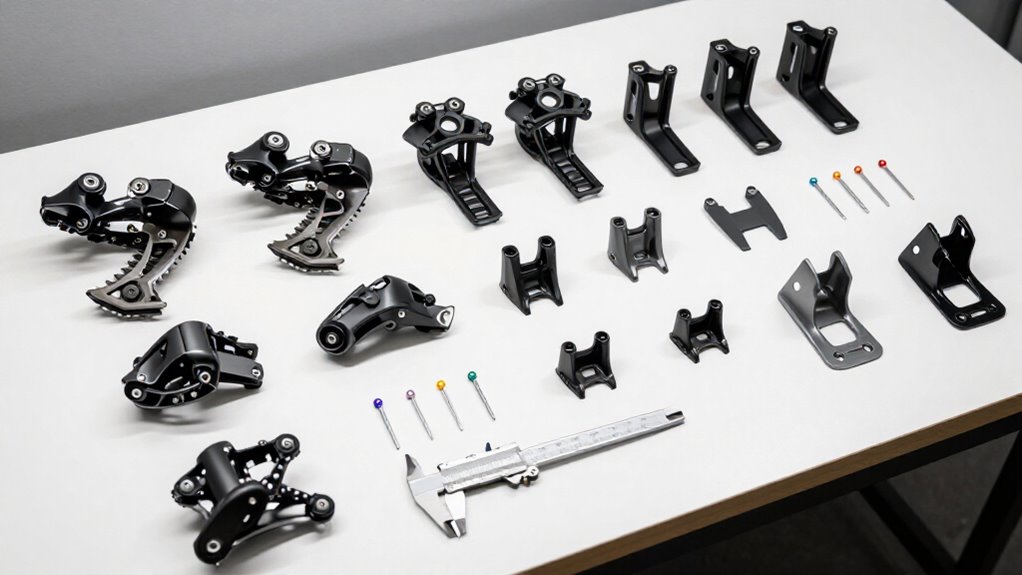
Compare Hanger Profile Silhouettes
Start by matching the hanger’s full profile silhouette to the listing for your exact bike brand, model, and model year. Compare the mounting plate’s angle, axle-interface contour, and every mounting-hole or threaded opening’s location. A correct Trek, Merida, Kona, or Commencal listing must match more than an outline.
Photograph both Side A and Side B in close-up, with outer edges, thickness, and axle area clearly visible. Check side-to-side offset: two hangers may share a similar hook shape yet position the derailleur differently. A small contour change, shifted thread, or altered plate thickness can identify a different fit.
If silhouettes remain nearly identical, confirm against additional frame and dropout details before ordering. This comparison helps prevent alignment errors, poor shifting, and clearance issues.
Carbon Dropout Damage Requires Inspection
If a carbon dropout shows cracks, chips, crushed fibers, or deformation, stop before matching or fitting a replacement hanger. Damage can move the hanger’s datum surfaces or axle interface, so a part that visually resembles a Trek Procaliber Hanger 453, Merida Scultura Hanger 697, or a Kona-specific unit may sit out of plane under load. That misalignment causes inconsistent indexing, chain noise, and frame or derailleur contact.
Photograph the original hanger from both sides, then photograph the dropout and mounting area clearly. Compare mounting-hole locations, thread or through-axle interface, and inside/outside profile against the original and frame. Don’t rely on model name, year, or silhouette alone.
Have a shop inspect the carbon laminate, mounting integrity, and alignment. Only install a confirmed hanger after inspection.
SRAM UDH on 2021+ Frames
Once the dropout passes inspection, confirm whether your 2021-or-newer frame uses SRAM’s Universal Derailleur Hanger (UDH) interface before ordering a legacy replacement.
UDH isn’t determined by model year alone. Check the manufacturer, model designation, and production year, then verify the specific frame revision in that brand’s compatibility documentation. Trek, Specialized, Canyon, and other brands may revise dropout hardware within a model family, so a 2021+ label doesn’t prove UDH fitment.
Compare your original hanger’s axle-side profile, locating features, and mounting design with a confirmed UDH-compatible part. Don’t substitute a visually similar legacy hanger: its geometry can misplace the derailleur and compromise shifting. If fitment remains uncertain, send clear photos of both hanger sides and the dropout area to the manufacturer or vendor for confirmation.
Cross-Threaded Hanger Bolt Fixes
A cross-threaded hanger bolt can keep the hanger from seating flush against the dropout, so remove it rather than forcing a replacement bolt through damaged threads. Treat the dropout and hanger as a matched interface: on a Trek Procaliber, Merida Scultura, or Kona Process, don’t assume a visually similar bolt shares its pitch or shoulder length.
- Remove the bolt, inspect both thread starts, and clean debris. Chase intact original threads with the correct tap or reamer; let a shop do it if resistance persists.
- If hanger threads are stripped, install a correctly sized Helicoil-style insert so the new bolt runs concentric and clamps evenly.
- Use the specified bolt, hand-start it, then photograph visible side threads and measurements for future reference before final installation.
Check Dropout Part Numbers
After resolving any cross-threading, verify the dropout part number stamped or printed near the rear axle before ordering a hanger. Start with your brand, model, and model year in the compatibility chart, then use that identifier to confirm—not assume—the listed fit. Trek, Merida, Kona, and Commencal frames can use closely related but noninterchangeable dropout designs.
- Match the bolt or slot pattern, thread type, and hanger offset to the chart’s model-specific entry.
- Photograph the dropout and removed hanger clearly; minor contours can change alignment, threads, or axle clearance.
- If numbers or fit remain unclear, submit photos and the dropout number through the site’s identification request.
Don’t install a look-alike: an incorrect mounting interface can misalign shifting or damage frame threads. Ask vendor support before purchase.
Conclusion
Use the chart as a starting point, then verify your frame’s hanger against the original Trek, Specialized, Giant, Cannondale, or Santa Cruz part number. You’ll need matching bolt orientation, axle interface, and profile, not merely a similar silhouette. Confirm whether your bike uses Shimano-standard, SRAM direct-mount, or UDH hardware.
On carbon frames, inspect the dropout before installing anything. If threads feel damaged, stop; you can’t safely correct cross-threading by forcing the bolt into damaged dropout threads.