Chainring Bolt Circle Diameter Compatibility Chart
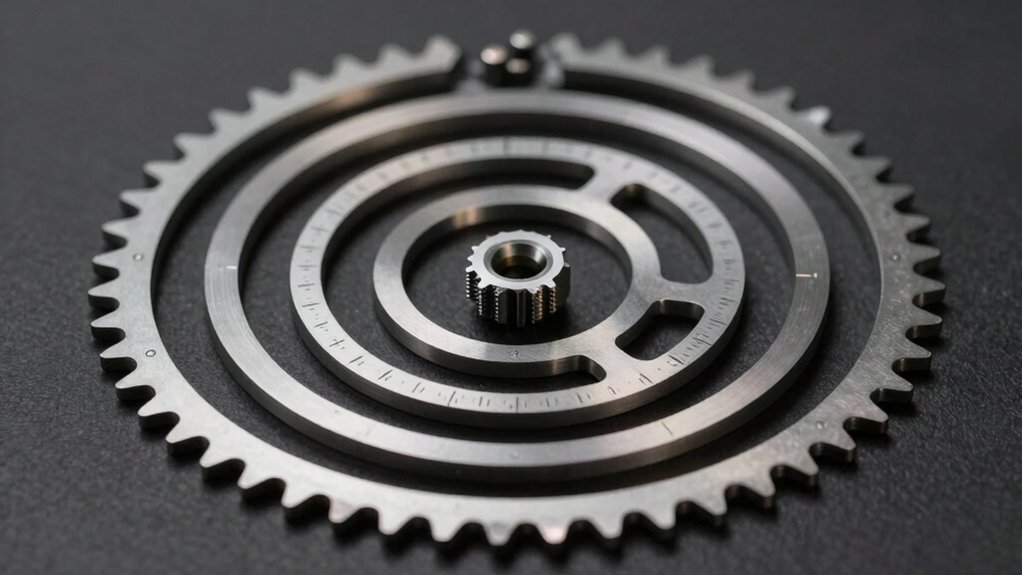
You’ll match chainrings by bolt count, exact BCD (measure adjacent center-to-center), and any asymmetric hole spacing. Use multipliers (4‑bolt ×1.414, 5‑bolt ×1.701, 6‑bolt ×2) to convert adjacent gaps to BCD quickly.
Only identical BCDs and matching angular patterns will fit; 110mm asymmetric and 130mm 4‑bolt require exact mates. Verify bolt hole diameter, seating and torque specs, and chainline/inner‑ring clearances to avoid interference.
Continue for a compact compatibility matrix and fitment checks.
What Is Chainring BCD Compatibility?
- BCD (bolt circle diameter) and bolt count determine ring fit. Measure adjacent bolt center distance to calculate BCD precisely.
- Use quick multipliers: 4‑bolt ×1.414, 5‑bolt ×1.701, 6‑bolt ×2 to convert adjacent spacing to BCD. Match BCD, bolt count, and hole angular pattern (including asymmetry) exactly for interchangeability.
- 130 mm requires standard 4‑bolt 130 BCD rings; other 4‑bolt BCDs (94, 104, 110) will not align. Verify bolt hole diameter, seating, chainline, and torque specs before installing multi‑ring setups.
BCD Compatibility Matrix
How do you confirm a chainring will fit your crankset? You measure adjacent bolt center-to-center distances (d) and apply BCD = d / sin(180°/n) or use multipliers (4‑bolt ×1.414, 5‑bolt ×1.701, 6‑bolt ×2). Verify bolt count and pattern. Asymmetry pitfalls demand measuring every adjacent pair because nonstandard spacing breaks interchangeability.
| Crank Input | Compatible Chainring |
|---|---|
| 94 mm (4/5) | 94 mm only |
| 104 mm (4) | 104 mm only |
| 110 mm (sym/asm) | Exact 110 pattern |
| 130 mm (5) | 130 mm only |
| Asymmetric patterns | Exact matched asymmetry |
If crank arms interfere, use calipers or a template. Match BCD, bolt count, and hole orientation; otherwise, compatibility fails.
Standard 4-Bolt 130MM Notes
If your crankset uses a standard 4-bolt 130 mm BCD, you’ll want chainrings specifically drilled for that 130 mm circle. Other 4-bolt BCDs (94, 104, 110 asym) won’t align. You should verify bolt center spacing and hole diameter before ordering replacements. 130 mm is common for standard road 53/39 setups; it’s not interchangeable with mid compact or asymmetric spacing patterns used on some cranks.
Confirm 130 mm BCD by measuring adjacent bolt center distance (≈76.4 mm) with calipers. Use rings labeled 4-bolt 130 mm; asymmetric 110 or 104 will misregister. Consider chainline and crank arm clearance. Some chainrings specify offset for mid compact setups.
When fitting, torque bolts to manufacturer spec. Inspect for full seating against the crank spider.
Tooth Count Limits and Spacing
When selecting a chainring for a given BCD, you’ll check maximum tooth counts and minimum tooth spacing to guarantee the teeth clear adjacent rings and frame components.
Calculate bolt-hole angular pitch to confirm bolt placement won’t interfere with large or inner rings. Verify inner-ring interference on multi-ring setups. Use those parameters to determine multi-ring compatibility and safe chainline geometry.
Maximum Tooth Counts
Several factors determine the maximum tooth count you can fit on a chainring: BCD limits the outer diameter and bolt clearance. Chainline and derailleur capacity restrict shiftability, and tooth spacing must match the drivetrain’s pitch. You’ll calculate maximum teeth by mapping ring outer diameter to BCD and ensuring bolt holes remain clear. Larger BCDs permit higher tooth counts but may conflict with crankarm geometry.
Verify tooth spacing matches chain pitch (e.g., 1/2″ for modern drivetrains) so engagement and shifting stay reliable. For multi-ring compatibility, check ramping, pin placement, and inter-ring spacing to avoid interference. Also, confirm derailleur cage capacity and limit screws accommodate the larger circumference; otherwise, you’ll need different cage length or cassette gearing.
Minimum Tooth Spacing
How small can you go before teeth and chain pitch stop meshing reliably? You must respect minimum spacing between teeth to maintain engagement with standard 1/2″ chain pitch. Minimum spacing is governed by tooth width, gullet radius, and chain roller geometry. Reducing tooth count tightens arc length per tooth and increases risk of poor seating, skip, and accelerated wear.
Use spacing guidelines: for 1/2″ pitch, maintain approximate arc length equal to pitch (12.7 mm) per tooth. Below ~20–22 teeth on narrow BCDs, you should verify radial clearance and tooth profile compatibility. When designing or selecting small rings, measure actual arc-tooth spacing and confirm chain wrap and derailleur chainline to avoid interference and ensure reliable mesh.
Bolt Hole Angular Pitch
Minimum tooth spacing sets a hard limit on how small a usable chainring can be. However, bolt hole angular pitch often becomes the governing constraint before you hit that tooth-count floor. You’ll evaluate angular pitch as the central angle between adjacent bolt centers. Smaller BCDs increase that angle; this reduces the number of available teeth before bolts intersect tooth gullet geometry.
For design and replacement, you must consult a bcd compatibility matrix to verify which tooth counts clear bolt holes and maintain chain engagement. In practice, standard 4 bolt 130mm notes matter because 130mm yields specific angular pitches that accommodate common road tooth counts (e.g., 39–53T ranges). Calculate angular pitch against intended tooth profile to avoid interference and ensure durability.
Inner Ring Interference
Inner-ring interference occurs when bolt holes encroach on tooth gullets or when bolt-head clearance reduces the allowable inner tooth count. You must verify that a chosen BCD and bolt pattern leave sufficient material between bolts and teeth.
You’ll calculate minimum tooth count by modeling bolt hole angular-pitch relative to tooth spacing: divide 360° by tooth count to get pitch angle. Then, ensure bolt centers avoid occupying the same angular sector as inner gullets.
Use precise BCD and bolt hole diameter to compute radial exclusion zones; subtract those from available ring material to find viable inner tooth profiles. For asymmetric or nonstandard patterns, simulate bolt hole angular pitch and eccentricity. Reject combinations where exclusion zones overlap tooth roots or reduce web thickness below manufacturer limits.
Multi-Ring Compatibility
Why do some chainring combinations fit while others don’t? You must consider tooth count limits, radial spacing, and BCD-derived bolt locations. Multi ring pairing requires that inner and outer tooth counts yield sufficient radial clearance and correct chainline. Mismatched teeth can cause heel-to-tooth interference or poor shifting.
Use a compatibility matrix to map allowable outer/inner tooth differentials per BCD and crank model. For given BCD (e.g., 110/130/144), determine maximum outer chainring teeth and minimum inner teeth so ramps and pins align and chainring teeth avoid contact. Measure actual bolt spacing and check for asymmetric patterns.
Verify prescribed manufacturer limits, often ±2–6T for optimal shift, and confirm visually on a jig before installation to prevent rubbing or dropout.
How Often Should You Check Your Chainring BCD Compatibility on a Bike?
You should inspect your chainring bcd compatibility at least once a month for routine riders and before every long ride if you commute daily or ride in wet or dusty conditions. Catching wear early keeps repair costs low and prevents the cascading damage that turns a small component issue into a full drivetrain or wheelset replacement.
Frequently Asked Questions
Can I Mix Chainrings From Different Manufacturers on One Crankset?
Yes, you can mix chainrings from different brands, but you’ll need to verify chainring compatibility carefully. Manufacturer variance in bolt spacing, tooth profile and ramping can affect shifting; therefore, match BCD, bolt pattern and intended front derailleur use.
You’ll get the best results when teeth counts and ramping styles align. Otherwise, expect compromised shifting. Inspect bolt positions and measure adjacent bolt distances to confirm crankset compatibility before installing.
How Do Asymmetric BCD Patterns Affect Chainline and Shifting?
Asymmetric BCD alters bolt offset so you’ll get slight radial and angular shifts in chainline effects; this moves the chainring mesh inboard or outboard.
For shifting considerations, you’ll need rings profiled for that offset and precise spacing to avoid chain rub or missed shifts. Compatibility implications mean you can’t assume interchangeability: match asymmetric BCD ring design to the crank’s offset and confirm tooth profiling, ramping, and chain width for reliable performance.
Are Bolt Lengths Different Between Single and Double Chainrings?
Yes, bolt lengths often differ between single and double chainrings because you’ll need appropriate bolt compatibility and correct chainring spacing. Single-ring setups usually use longer bolts or spacers to clear narrow-wide rings and direct-mount spiders.
While doubles use shorter bolts accounting for stack height between inner and outer rings. Always measure stack height and thread engagement; then choose bolts specified by the crank/chainring manufacturer for secure fit and optimal shifting.
Can I Use a 5-Bolt Ring on a 4-Bolt Crank With Adapters?
No, you generally can’t use a 5-bolt ring on a 4-bolt crank without serious compromise. 4 bolt compatibility requires matching BCD and bolt spacing. Adapters attempt to bridge geometry, but they introduce misalignment, uneven loading, and fastener clearance problems.
Adapter risks include stripped threads, chainring wobble, and premature wear or failure. If you need different bolt patterns, replace the crank or use purpose-made chainrings designed for your crank’s BCD.
Do BCD Measurements Change if Chainrings Are Oval or Non-Round?
No, BCD measurements don’t change for oval or non-round rings. You still measure the bolt centers on a theoretical circle.
You’ll need to account for oval variables when assessing non-round compatibility because some oval rings offset bolt positions slightly or use proprietary mounting. Measure actual center-to-center bolt distances and confirm manufacturer specs. If offsets exist, matching BCD alone may not guarantee fit; therefore, check bolt pattern and adapter compatibility.
Which Chainring BCD Standard Approach Is Right for Your Bike?
You’ve seen how BCD dictates which chainrings will fit your crank: the 4-bolt 130mm standard works with a specific tooth range and angular pitch. Larger or smaller BCDs change maximum tooth counts and spacing. You’ll need to check inner-ring clearance and bolt-hole alignment to avoid interference on multi-ring setups.
Use the matrix to match bolt circle, tooth count, and pitch precisely so you can install rings that maintain chainline, shifting, and safe clearances.
Related reading: 110 BCD Chainrings — a closer look at this topic.