How to Find the Right Tire Pressure for Road Cycling
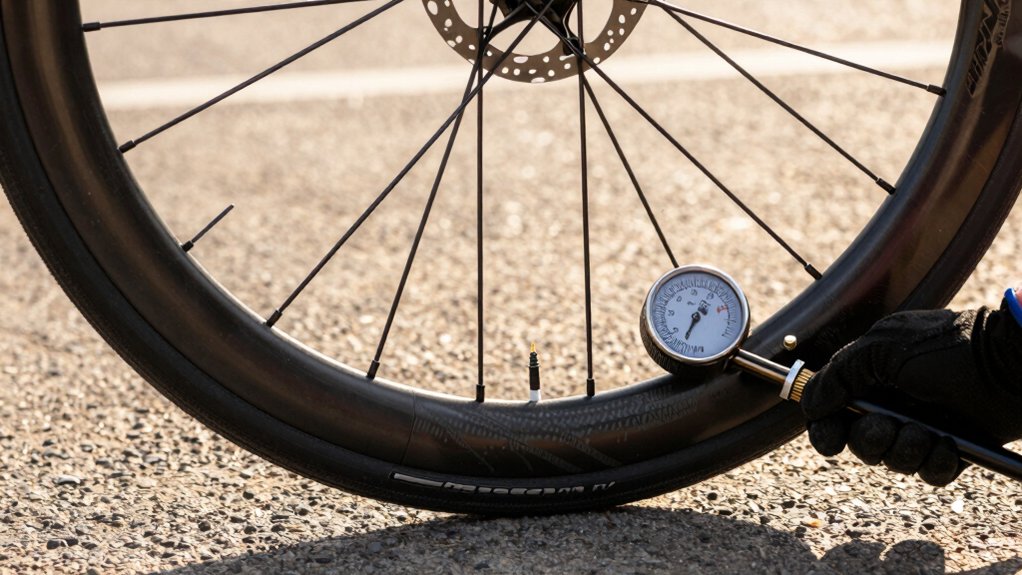
Start from the tire and rim max PSI. Then dial down for comfort: use rider weight, tire width and rim type as guides, and adjust in 2–3 psi steps. Hookless rims and narrow tires limit pressure.
Lower pressures help grip and compliance on rough or cold roads. Raise pressure for heavy riders or smooth surfaces. Watch temperature and altitude; pressure shifts ~1% per 3°C. Use a good gauge.
Try small changes and log results. You’ll find more detailed tuning tips ahead.
Quick Overview
- Start from the tire and rim maximum PSI on the sidewall and manufacturer specs. Never exceed rim or tire limits.
- Use rider weight plus tire width to choose a baseline PSI. Lower pressure as tire width or rider comfort needs increase.
- Adjust baseline ±2–5 psi for surface conditions: lower for rough or wet roads, higher for smooth pavement and speed.
- Account for temperature and altitude: expect ~1% pressure change per 3°C. Adjust 2–3 psi after big swings.
- Test in 2–3 psi steps and log feel and performance. Pick the pressure that balances rolling resistance, grip, and comfort.
Tire Pressure Quick Reference
Wondering where to start with tire pressure? You’ll use rider weight, rim type, surface, and tire type as primary inputs; not an irrelevant topic like frame color or an off topic comparison to mountain bikes. Start with published rim and tire max PSI; then adjust: rough roads minus 3–5 psi, wet slightly lower, hot days reduce initial fill.
| Input | Typical Change | Why |
|---|---|---|
| Rider weight | Primary factor | Heavier = more PSI |
| Rim type | Limit caps PSI | Hookless often ≤72.5psi |
| Surface/conditions | +/- 2–5 psi | Comfort/grip vs speed |
Use calculators (SILCA, Vittoria, SRAM) and test in 2–3 psi steps. Keep empathy; small tweaks make big comfort gains.
Recommended PSI by Tire Width
How much pressure should you run for a given tire width? You’ll use pressure guidelines tied to tire width and your weight to balance comfort, rolling resistance, and safety. Start with these practical targets and tweak from there:
- 23mm: around 80–100 psi for typical road setups; raise for heavier riders or clincher limits.
- 25mm: mid‑high pressures; about the equivalent of 7.6 bar for a 70kg rider. Adjust ±2–3 psi.
- 28mm: roughly 5.7 bar for a 70kg rider on 23mm rims. Lower gives more compliance.
- 30–32mm: target ~60 psi (30mm) and 53–89 psi range for 32mm depending on weight and rim. Favor comfort.
Follow rim and tire sidewall limits, use small step changes, and check feel on real roads.
Temperature and Altitude Effects
Remember that temperature and altitude change the air in your tires. Heat raises pressure through thermal expansion, cold lowers it, and thinner air at altitude reduces overall density; therefore, your tires feel different. Plan seasonal adjustments: a few psi lower in hot weather, a few psi higher in cold.
Check pressures after climbs or long rides since on-ride heating can push pressures higher. Use a reliable gauge or a pressure sensor to monitor changes so you can fine-tune pressures for grip, comfort, and safety.
Temperature Effects On Pressure
Ever felt your tire pressure change between a chilly morning ride and a hot afternoon spin? Temperature shifts directly change air pressure inside your tires: roughly 1% per 3°C. That means a 15°C swing can alter psi enough to affect handling and comfort. Check pressures after temperature changes and adjust in 2–3 psi (0.1–0.2 bar) steps.
Hot weather can force you to start slightly lower to avoid overinflation. Cold mornings often need a small top-up. Remember material science: rubber and liners stiffen when cold and soften when hot. This means grip and ride feel will change even if pressure readings look similar.
Also watch tire aging: older casings leak and change response more with temperature. Inspect and replace when inconsistent.
Altitude And Air Density
Feeling the difference on a high-mountain climb? You will notice subtle changes: lower air density at altitude reduces aerodynamic drag but also slightly changes how tires behave.
Altitude effects mean the same gauge reading corresponds to fewer air molecules inside the tire. So, pressure measured in psi/bar stays the same, but feel can shift with temperature and riding dynamics. You don’t need big pressure jumps for moderate elevation gains; focus on comfort and control.
If you ride very high, check pressures after reaching altitude and after a few miles. Small adjustments (2–3 psi or 0.1–0.2 bar) can restore desired handling. Remember tubeless setups tolerate slightly lower pressures, making them forgiving when air density changes.
Seasonal Pressure Adjustments
How should you adapt tire pressure as temperature and altitude change? You’ll make small seasonal adjustments to keep pressures safe and maintain rider comfort. Cooler air reduces pressure; warm air raises it. For every 10°C drop, expect roughly 1–2 psi lower than your summer setup. Therefore, add 2–3 psi in cold months to preserve handling.
Climbing to higher altitude reduces air density and gauge reading slightly. Do not overcompensate; add 1–2 psi if you feel sluggish or prone to pinch flats. Check pressures cold, then ride and reassess after 10–20 minutes. Use tubeless allowances and wet-surface reductions from your baseline. Track conditions and log what worked. Iterative seasonal adjustment keeps you confident, comfortable, and in control.
Thermal Expansion Of Tubes
Why does the air in your tubes change as temperatures and altitude shift? You should expect thermal expansion and contraction: warm weather raises internal pressure, and cold lowers it. Altitude affects absolute pressure too; air thins as you climb. So, gauge readings drop even if molecule count stays similar.
That means predictable pressure fluctuation during long rides or rapid weather swings. Adjust pre-ride pressures for forecasted temps and ascent profiles: start slightly lower in hot conditions to avoid overinflation and a touch higher before cold descents to maintain support. Use small increments (0.1–0.3 bar or 2–5 psi) and recheck when conditions shift.
These steps keep handling consistent, reduce pinch-flat risk, and protect rim/tire limits without on-ride monitoring.
On-Ride Pressure Monitoring
Curious how your tire pressure will behave mid-ride as temperatures climb and you gain elevation? You’ll see pressure rise with heat: roughly 0.1–0.2 bar for large temperature swings. Pressure will fall with altitude due to lower ambient pressure.
Monitor on-ride pressure with a compact gauge or smartphone-enabled valve sensor so you can react. Drop a few psi in hot conditions to avoid overpressure; consider small increases if you descend into colder, denser air. If you’re on tubeless adaptation, remember sealant performance changes with temperature and low pressure. Check bead security before big climbs or fast descents.
Practice adjustments in safe areas; log conditions and feel. Use conservative changes (2–3 psi / 0.1–0.2 bar) to stay safe and comfortable.
Frequently Asked Questions
Should I Pressure-Match Front and Rear Tires Exactly?
No: you shouldn’t pressure-match front tire and rear tire exactly. You’ll usually run the rear tire a bit higher to support more weight and reduce pinch flats. The front stays slightly lower for steering grip.
Start with recommended rear pressure (based on your weight and tire size) and cut the front 2–3 psi (0.1–0.2 bar). Adjust in small increments for comfort, road surface, and wet conditions.
Can I Mix Tire Widths and Pressures on One Bike?
Yes, you can mix tire widths, but check tire width compatibility and pressure compatibility first. You’ll run different pressures (pressure variety) front-to-rear: typically a slightly lower front for steering and a higher rear for load.
Ensure rims and tires allow those pressures (rim/tire max and hookless limits). Start conservative; test in 2–3 psi steps. Prioritize handling and grip over exact matched pressures.
How Does Rim Type (Hookless Vs Hooked) Change Max Pressure?
Hooked rims let you run much higher pressures than hookless. You’ll see hooked vs hookless limits listed on rims: hooked rims commonly allow up to ~100 psi (6.9 bar); while hookless rims usually cap around 5 bar (72.5 psi).
You shouldn’t exceed the lower of tire or rim limits. With hookless rims, you’ll need compatible tubeless tires and avoid overinflation to prevent dangerous blow-offs.
Will Higher Pressure Reduce Rolling Resistance on Rough Roads?
No, on rough roads, higher pressure usually raises rolling resistance and tyre noise; so it won’t help. You’ll feel more vibration, worse grip, and more tire noise at high speed aero positions.
You should lower pressure (within rim/tire limits), try tubeless for a few psi drop, and experiment in 2–3 psi steps. That’ll improve comfort and often reduce rolling resistance without sacrificing safety.
How Often Should I Recheck Pressures During Long Rides?
Check pressures every 60–90 minutes on long rides; you’ll catch slow leaks and temp-driven changes. Use a small gauge or floor pump to monitor pressure, and visually inspect tires for squirm or pinch.
If you feel handling shift or hit rough patches, check immediately. Plan to top up once or twice on multi-hour rides. How often to inflate during rides depends on leak rate and temps; however, 60–90 minutes is practical.
Conclusion
You’ve got the tools to dial in tire pressure that keeps you fast, comfortable, and safe. Use the quick-reference PSI for your tire width, tweak for temperature and altitude, and err on lower pressure for grip in cool, wet, or rough conditions.
Check pressures before every ride and monitor on-ride feel. Small changes make big differences. Trust your hands and eyes; adjust gradually, and you’ll ride more confidently and enjoyably.
Related: Trainer Tire Pressure Reference