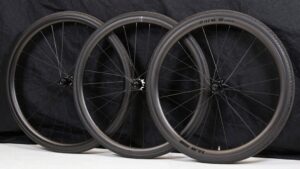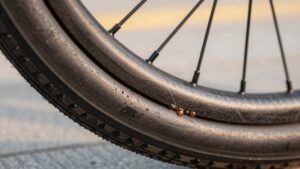
How Tire Width Affects Ride Comfort and Speed
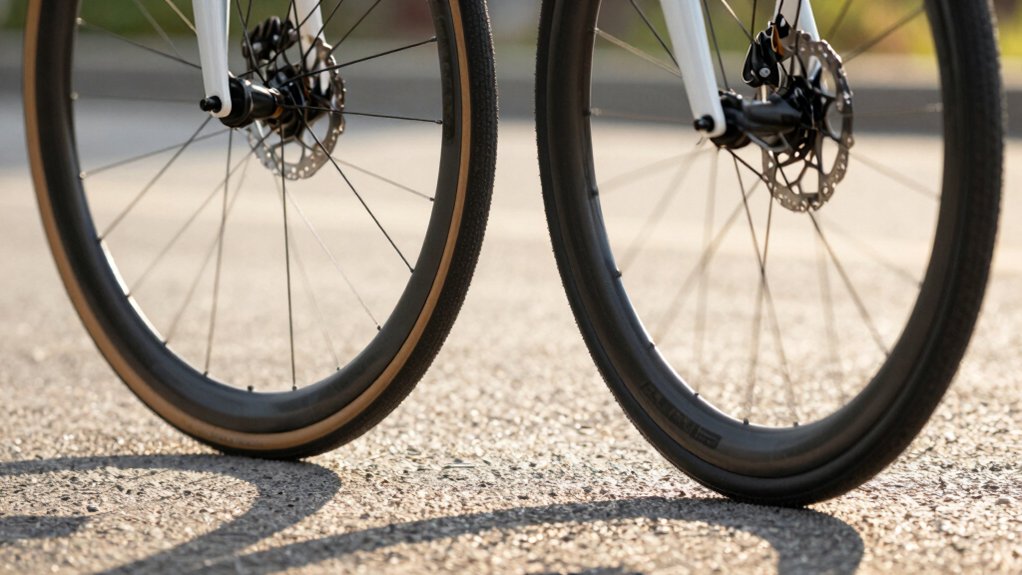
You’ll trade speed for comfort by choosing tire width and matching rim width to the surface and load.
When rim internal width is about 65–75% of tire width, you’ll hit lowest rolling resistance. Wider tires let you run lower pressures to cut vibration losses on rough pavement or gravel.
Narrow 23–28mm suits smooth roads; 32–40mm balances mixed and coarse gravel; very wide tires float loose surfaces. Continue for pressure charts, terrain-specific widths and measurement tips.
Quick Overview
- Wider tires with greater volume increase comfort by lowering pressure and reducing vibration transmitted to the rider.
- On smooth pavement, narrower tires (23–28mm) often give slightly lower rolling resistance and higher speed potential.
- Matching rim width to tire size (rim ~65–75% of tire width) minimizes rolling resistance for best efficiency.
- On rough or gravel surfaces, 32–40mm or wider tires roll faster overall by absorbing bumps and maintaining traction.
- Wider rims let you run lower pressures safely; this improves compliance without greatly increasing rolling resistance.
Tire Width vs Rolling Resistance
Although many riders assume narrower equals faster, controlled tests show rim and tire matching drives rolling resistance more than absolute tire width. Peak RR occurs when rim internal width is about 65–75% of tire width; with 50–80% delivering within 1% of that peak. You should match rim width to tire width to minimize rolling resistance. Data show road 25mm tires hit lowest RR near 17–18mm rims, while 38mm gravel tires perform best near 26mm rims.
Pressure effects matter: at equal PSI, wider tires lower RR via reduced deflection. Optimize volume, not just width, and expect diminishing returns beyond the 65–75% ratio.
| Metric | Recommendation |
|---|---|
| Ratio | 65–75% optimal |
| Pressure | Scale to volume |
Tire Pressure Quick Chart
Matching rim and tire width sets the baseline for rolling resistance; pressure is the variable you can adjust to tune comfort, grip, and speed. You’ll use tire pressure to balance energy losses and compliance: higher pressure lowers deformation losses on smooth pavement. Lower pressure improves comfort and grip on rough surfaces. Adjust pressure based on rider weight, wheel size, and rim width. Wider rims allow slightly lower pressures without pinch flats and improve contact patch shape. Use a pressure chart as a starting point; then refine with power and vibration measurements.
70–90 psi: narrow rims (15–17mm) with 23–25mm tires — low rolling loss on smooth roads.
50–70 psi: mid rims (17–21mm) with 25–32mm tires — balanced performance.
30–50 psi: wide rims (21mm+) with 32mm+ tires — comfort and control on rough surfaces.
Recommended Tire Widths by Terrain
You should match tire width to surface: narrower 23–28mm for very smooth pavement where low rolling resistance matters; 32–40mm for gravel to maximize traction and compliance; and 28–32mm as a compromise for mixed surfaces.
For touring, favor 32–40mm or wider to run lower pressures and reduce vibration fatigue over long distances. For racing on clean roads, stick to slim profiles (23–28mm) to minimize aerodynamic and contact-area penalties while preserving handling.
Road Smoothness Match
How rough is the road you’re riding determines the most efficient tire width: on smooth pavement, 23–25mm tires perform comparably to wider options. However, as surface irregularities increase, widths of 28mm+ paired with 21mm+ internal rims deliver measurable comfort and rolling-efficiency gains.
You should match tire setup to measured surface PSD (power spectral density) and RMS vibration. Low-PSD smooth asphalt yields negligible penalty for 23–25mm, while medium-to-high PSD urban chipseal and broken pavement show reduced power loss and vibration at 28–40mm.
Don’t conflate aesthetic preference or an irrelevant topic or off topic concept with performance decisions; use empirical roll-down and power-meter data to select width and pressure. Adjust pressure downward with wider rims to maximize compliance without pinch risk.
Gravel Traction Needs
Why choose wider tires for gravel? You’ll gain increased gravel traction because a wider tire increases contact patch area and lowers optimal pressure, improving grip on loose aggregates. Field tests show 32–40mm tires balance rolling efficiency and puncture resistance on coarse gravel; 40–54mm excels where deep loam or washboard demands flotation.
Match tire width to expected road surface: compacted dirt tolerates narrower 30–35mm choices at higher pressures, while fragmented rock requires wider, softer setups. Measure slip angles and sinkage during calibration rides. Wider tires reduce lateral slip and decrease vibration-induced loss of control.
For predictable braking and consistent cornering on mixed gravel, prioritize widths that let you run lower pressures without burping or pinch flats to maximize traction and ride stability.
Mixed-Terrain Compromise
After matching gravel traction needs to tire width and pressure, pick compromises that balance comfort, grip, and rolling efficiency across surfaces. You’ll typically choose 32–38mm for mixed routes: wide enough to run low pressures, reducing vibration and improving compliance; yet narrow enough to limit aerodynamic and weight penalties on pavement.
Data show 32–35mm on 21–25mm internal rims gives measurable comfort gains and similar roll efficiency to narrower tires on rough roads. Meanwhile, 36–38mm adds puncture protection and flotation on soft tracks.
Don’t treat this as an unrelated topic or make an irrelevant comparison to pure road or pure MTB setups. Optimize for the dominant surface percentage. Adjust pressure ±5–10% based on load and expected roughness for best compromise.
Touring Comfort Widths
For long-distance touring, you should pick tire widths by terrain to balance comfort, durability, and sustained efficiency: 28–32mm on primarily paved routes for lower rolling resistance and predictable handling; 32–38mm for mixed roads where compliance at lower pressures reduces rider fatigue without large speed penalties; and 38–45mm (or wider) for sustained gravel, soft tracks, or heavily loaded tours to maximize puncture resistance, flotation, and vibration damping.
You’ll prioritize tire width based on surface roughness, expected loads, and desired pressure range. Data show widths ≥28mm allow meaningful pressure reduction and improved compliance without measurable rolling resistance penalties on smooth pavement. They also deliver lower effective rolling resistance on rough surfaces.
Choose wider options when fatigue mitigation and puncture resilience outweigh marginal aerodynamic or weight costs.
Racing Slim Choices
How narrow should you go when racing varied terrain? You’ll prioritize a narrow variance strategy: aim for 25–28mm on clean pavement, 28–32mm for mixed surfaces, and 32–38mm when loose or rough sections dominate. Data show sub-25mm widths increase vibration frequency and perceived speed without power gains.
Widths of 28mm+ let you run lower pressures for better chassis comfort and reduced rolling resistance on broken pavement. On gravel, 32–38mm paired with wider internal rims stabilizes sidewalls and improves compliance. Choose the narrow end when minimizing aerodynamic drag on smooth courses, but shift toward wider choices as surface roughness index rises.
Calibrate pressure to terrain and rim width to optimize grip, braking, and long-stage comfort.
Frequently Asked Questions
Do Wider Tires Increase Brake Cooling or Heat Buildup?
Wider tires don’t meaningfully increase brake cooling and can slightly raise heat buildup near hubs due to larger contact patch slowing wheel cooling airflow.
Aerodynamics matter more: wider rims and tires change airflow patterns, which can marginally reduce convective cooling of rotors or hubs. Measured thermal effects are small. Brake cooling is dominated by rotor design, airflow management, and braking duty cycle, not tire width alone.
How Does Rim Width Affect Tubeless Seal Reliability?
You’ll see rim width directly influences tubeless seal reliability: wider rims generally improve seal by supporting tire bead and creating a flatter tire profile that holds sealant and pressure better.
Matching rim width to tire width reduces bead stretch and leakage risk. Too-wide rims with narrow tires can compromise the tubeless seal. Monitor bead seating, use correct tape/valve, and note brake cooling isn’t directly affected by rim width in this context.
Do Wider Tires Change Bike Fit or Frame Clearance?
Yes, wider tires can change your frame fit and require increased tire clearance. Measure current tire clearance at chainstays, seatstays, fork, and brake calipers. Add approximately 3–6mm per side for mud/debris and flex.
Check manufacturer max tire specs and rim internal width compatibility; wider rims often increase measured tire width. If clearance is tight, you will need a different frame or fork or a narrower tire/rim combo to maintain safe, reliable frame fit.
Are Wider Tires More Prone to Punctures or Debris Cuts?
Not necessarily; wider tires don’t inherently increase tire puncture risk. You’ll often run lower pressures and larger contact patches that deflect sharp objects, reducing punctures and debris cuts versus narrow, high-pressure tires.
However, wider tires expose more tread area to hazards and require proper rim sealing for tubeless setups to prevent leaks. Use robust puncture-resistant layers and correct pressure ranges. Field tests show net equal or reduced puncture incidence.
How Does Tire Width Impact Aerodynamic Drag at High Speed?
Wider tires increase aerodynamic drag; so at high speed, you’ll lose some high speed efficiency as frontal area and flow separation grow. Measured differences: shifting from 25mm to 28–32mm can add several watts of drag at 40 km/h. Very wide 40–55mm tires on wide rims add more.
You’ll balance rolling-resistance gains against aerodynamic penalties. In time-trialing, you’ll typically prioritize lower frontal area for peak efficiency.
Conclusion
You’ll choose tire width by balancing rolling resistance, comfort, and traction. Wider tires lower rolling resistance on rough surfaces and let you run lower pressures for more comfort and grip. Narrower tires can be faster on ultra-smooth pavement at higher pressures.
Match width to terrain: 23–28 mm for racing, 28–35 mm for mixed road/touring, 35–45+ mm for gravel. Use the pressure chart to optimize contact patch and minimize vibration while keeping puncture risk acceptable.
Related: Fat Bike Rims 80mm