Cycling Speed and Cadence Calculator
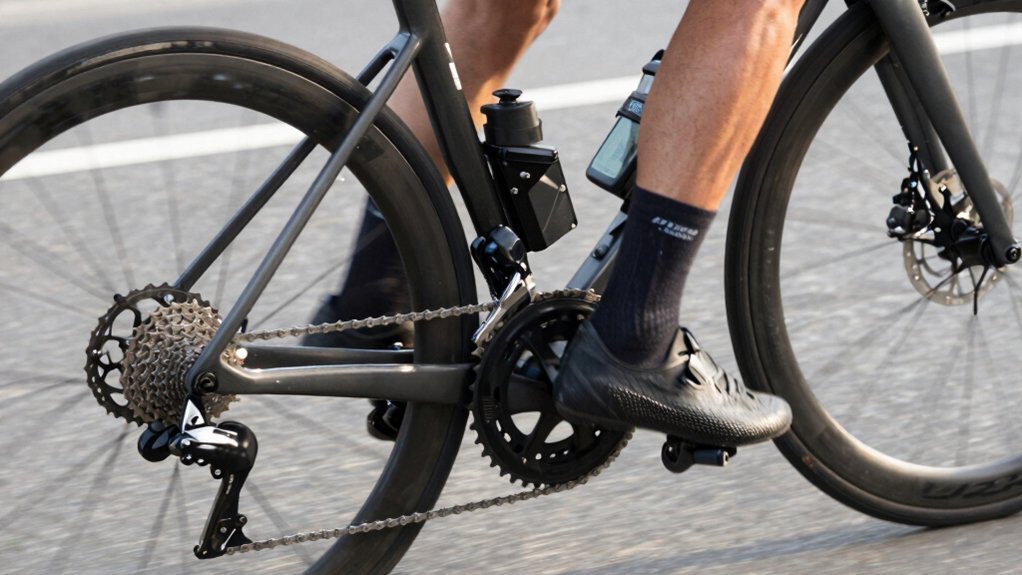
Use your measured wheel roll-out (not nominal size), actual tire pressure and load, and exact chainring-to-cassette ratio to convert cadence into speed precisely. Compute gear ratio = chainring teeth / cog teeth. Then Speed (km/h) = cadence (rpm) × gear ratio × wheel circumference (m) × 0.06.
Account for tire deformation from pressure and payload; since circumference shifts speed per stroke. Compare cassette step sizes to keep cadence within 70–90 rpm for efficiency. You’ll find practical setup tips ahead.
Quick Overview
- Use effective wheel circumference (measured roll-out) rather than nominal tire size to convert cadence into accurate speed.
- Compute gear ratio as chainring teeth divided by cog teeth. Then multiply by circumference to get meters per crank revolution.
- Convert cadence (RPM) to speed: Speed (km/h) = cadence × gear ratio × circumference (m) × 60 / 1000.
- Account for tire pressure and load because deformation changes effective circumference and thus speed per cadence.
- Choose chainring/cassette steps to keep cadence in your target range (e.g., 70–90 RPM) across expected speeds.
Wheel Circumference Comparison
How does tire choice change the distance you travel per pedal stroke? You evaluate wheel circumference by rim diameter and tire profile: larger ETRTO rims and wider tires increase circumference; so each pedal revolution covers more ground. Use precise mm values for calibration: 700x23C ~1944 mm vs 700x47C ~2268 mm yields a 324 mm difference per revolution.
Tire pressure subtly alters circumference via sidewall bulge. Low pressure increases circumference; high pressure reduces it. For accurate speed/distance calculations, input measured circumference into your computer.
| Wheel Type | Typical Circumference (mm) |
|---|---|
| 700x23C (road) | 1944 |
| 700x47C (gravel) | 2268 |
| 29″x2.0 (MTB) | ~2293 |
Tire PSI and Load Limits
Why does tire pressure matter as much as tire size? You’ll see tire pressure alters rolling resistance, contact patch, and thus effective wheel circumference used in gear ratio calculations and wheel circumference comparison. You must match pressure to load rating and payload to preserve speed and handling.
- Measure tire pressure against load rating: Underinflation increases deformation, lowers effective wheel circumference, and complicates gear ratio calculations.
- Overinflation reduces traction and can skew wheel circumference comparison data used for optimal cadence matching.
- Adjust pressure considering chainring ratios, chainring size effects, and cassette gear steps so cadence targets remain achievable.
- Use precise pressure tables and test runs to quantify tire pressure impact on speed and cadence for your setup.
Chainring and Cassette Ratios
You’ll examine how chainring size and cassette steps determine attainable gear ratios and their incremental changes. Use gear ratio = chainring teeth / cog teeth together with effective wheel circumference to convert ratios into speed per cadence.
Then match those speeds to your optimal cadence range to select ring/cassette combinations that keep you in efficient power zones.
Chainring Size Effects
Which chainring size should you pick to hit target speeds without overspinning or grinding? You evaluate chainring selection by matching gear tooth count to desired speed ranges and preferred cadence. Use the gear ratio (chainring teeth divided by cog teeth) and wheel circumference to compute speed per RPM precisely.
A larger chainring raises speed for a given cadence but increases required torque. A smaller ring reduces torque demand but forces higher cadence to maintain speed. For training or steady efforts, pick a chainring that keeps your cadence within your optimal range (e.g., 70–90 RPM) at target speeds. Calculate expected cadences across cog choices; then select the chainring tooth count minimizing extreme cadences while respecting power and cadence constraints.
Cassette Gear Steps
Now that you’ve matched chainring size to target speeds and cadence ranges, inspect how cassette gear steps alter usable ratios and cadence control. You’ll evaluate cassette steps by their tooth increments and distribution across the cog cluster. Smaller, uniform steps let you fine-tune cadence with minimal speed perturbation, while wide steps change cadence more abruptly.
Quantify each step as delta ratio = chainring/cog_n − chainring/cog_n+1 and translate to delta speed via wheel circumference. When you choose cassette spacing, prioritize step sizes that maintain cadence within your optimal band across terrain.
Consider cumulative step patterns: closely spaced low gears aid climbing cadence consistency. Larger jumps in high gears facilitate top-speed leverage. Measure effects empirically with known wheel circumference and cadence monitoring.
Gear Ratio Calculations
How do chainring and cassette ratios combine to define your effective gear? You compute gear ratio as chainring teeth divided by cog teeth; that scalar multiplies wheel rotations per pedal revolution.
Given wheel circumference, gear ratio converts cadence into linear speed directly: speed = cadence × gear ratio × wheel circumference (with unit conversions). Analyze discrete chainring/cassette combinations to produce a table of gear ratios and corresponding speed per RPM.
Use two word discussion ideas to structure comparisons: “ratio spacing”, “shift timing”, “power transfer”. That lets you model cadence optimization across ranges and choose chainring/cassette pairings minimizing cadence jumps while targeting desired RPM bands.
Precise tooth counts reveal quantized steps; optimize selections to keep cadence within efficient physiological ranges.
Effective Wheel Circumference
Effective wheel circumference ties your chainring and cassette ratios to the actual linear distance your bike moves per pedal revolution; it is what converts the abstract gear ratio into actionable speed and cadence targets.
You calculate effective wheel by multiplying wheel circumference (π × diameter plus tire thickness adjustments) by the gear ratio (chainring/cog). That yields meters per crank revolution, which you use with cadence to compute speed. For precise setup, perform a circumference comparison between measured roll-out and theoretical values to correct tire deformation and pressure effects.
You’ll store corrected effective wheel in the calculator to convert any cadence to km/h or mph accurately. This links chainring and cassette choices to repeatable speed outputs for training and gearing decisions.
Optimal Cadence Matching
Why match chainring and cassette ratios to your cadence range? You optimize drivetrain gearing so your preferred RPM falls within mechanically efficient ratios, minimizing cadence variability and preserving energy efficiency. First compute gear ratio (chainring/cog) and rear circumference. Then map cadence to speed via Speed = cadence × gear ratio × circumference.
Select chainring and cassette combinations that keep typical efforts (endurance: 70–90 RPM; race: 90–100+ RPM) near torque-optimal zones to reduce muscular spikes. Use smaller jumps between sprockets to limit cadence variability during shifts. For climbs, prioritize lower ratios to maintain cadence without excessive torque. For flats, choose higher ratios to exploit momentum.
Validate selections against target speeds and training goals. Iterate cassette steps to balance cadence stability and performance.
Frequently Asked Questions
How Does Wind Affect Calculated Speed and Cadence Targets?
Wind increases wind drag, so you’ll need higher cadence or a bigger gear to maintain target speed. Coasting efficiency drops sharply into headwinds. You’ll calculate higher power requirements for the same speed; this shifts cadence targets upward to offset added aerodynamic losses.
In tailwinds, drag decreases, letting you lower cadence or gear while keeping speed. Quantify wind effects by adding aerodynamic force to rolling resistance when solving speed/cadence equations.
Can Cadence Training Reduce My Injury Risk Long-Term?
Yes, cadence training can reduce injury risk long term. You’ll lower joint loads by using higher RPMs; distribute muscular stress; and improve neuromuscular control, which mitigates overuse patterns linked to cadence injury.
Systematic drills, such as progressive cadence ranges and torque intervals, enhance tissue resilience and fatigue resistance for long-term racing. You’ll still need load management, bike fit, and strength work to address individual biomechanics and sustain these protective effects.
How Accurate Are Smartphone GPS Speed Readings?
Smartphone GPS speed accuracy is generally good for steady outdoor cycling, but it’s variable. You’ll see typical errors of ±0.5–3 km/h due to satellite geometry, signal multipath, and sampling rate. Instantaneous readings lag and fluctuate; averaging over 5–30 seconds improves precision.
Urban canyons, tree cover, and device antenna quality worsen accuracy. For high-precision needs, use an external GPS receiver or wheel/cadence sensor fusion to reduce error.
Should I Prioritize Cadence or Power for Training Goals?
Prioritize power planning when your goal is objective performance gains. Cadence vs. power is complementary; however, power gives measurable training load and progress.
You’ll use cadence to optimize neuromuscular efficiency, reduce fatigue, and tune technique. But base intervals, pacing, and periodization on power targets (W/kg, FTP).
Combine both: set power zones, then prescribe cadence ranges for each zone to train economy and sprint-specific mechanics.
How Do Altitude and Air Density Change Real-World Speed?
Higher altitude reduces air density, so you’ll face less aerodynamic drag and thus higher real-world speed for the same power. Air density falls roughly exponentially with altitude; lowering drag force proportionally. At 2,000 m, you’ll see ~20% less air density versus sea level. You’ll therefore need less power to sustain a given speed, or you’ll go faster at constant power.
Adjust pacing and cooling expectations since reduced oxygen affects aerobic output.
Conclusion
You now have the tools to quantify how wheel circumference, tire pressure, chainring/cassette ratios, and effective wheel circumference interact to determine speed at a given cadence. Use precise gear-ratio calculations to predict speed and required cadence. Account for tire deflection under load and match cadence to terrain for efficiency.
Apply these analytical steps to select chainring sizes and cassette steps that keep you in optimal cadence zones while minimizing mechanical loss and preventing tire overloading.
Related reading: How to Use Cadence and Heart Rate Together — a closer look at this topic.