Road Bike Gearing Explained: Cassettes, Cranksets & Ratios
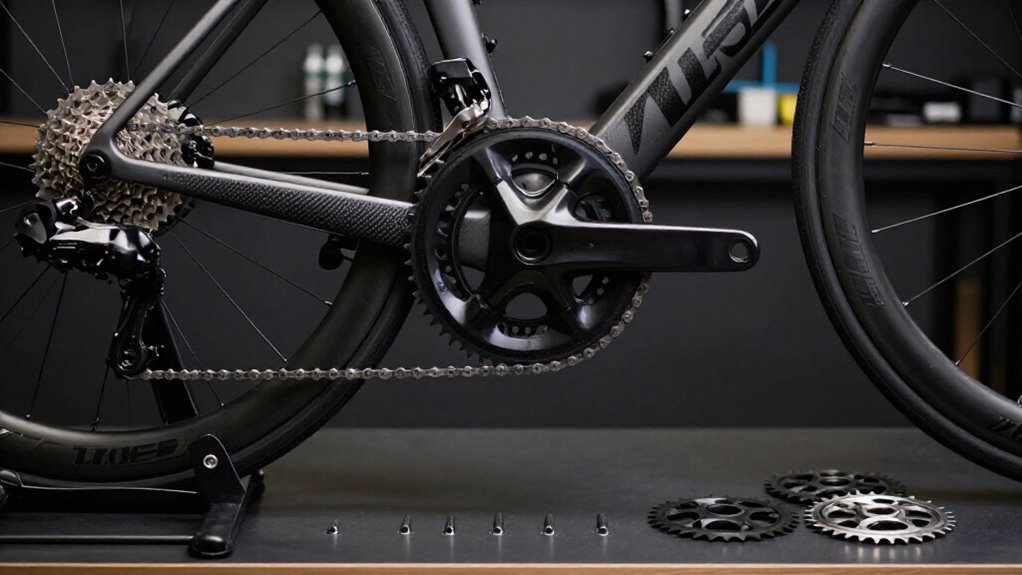
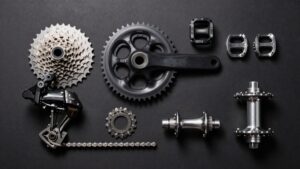
Your gear ratio equals chainring teeth divided by cassette-cog teeth: lower ratios ease climbs, while higher ratios increase distance per pedal turn and required torque. A 50/34 crankset with an 11,34 cassette gives you a 1.0 low gear and 4.55 top ratio; a 52/36 with 11,28 suits rolling terrain.
Before changing parts, confirm maximum-cog rating, total derailleur capacity, freehub compatibility, chain length, and B-tension. The details below will help you choose confidently for your routes.
50/34 Cranks, 11–34 Cassettes
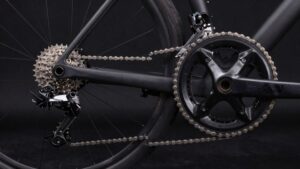
A 50/34 compact crank paired with an 11/34 cassette gives you a particularly wide road-bike range: the 50T outer ring supports speed on flats, while the 34T inner ring and 34T largest sprocket produce a 1.0 low ratio (34 ÷ 34) for steep climbs.
With two chainrings, you shift at the front to access overlapping ratios across the cassette. At the fast end, 50/11 equals approximately 4.55, giving the setup a broad overall span.
Relative to an 11/32 cassette, the 11/34 retains the same top gear and adds a lower bottom gear. Before fitting one, you’ll need to confirm that your rear derailleur’s maximum-sprocket specification accepts 34T. Also verify chain length and adjustment: adequate B-tension and clearance help the upper pulley track the large sprocket.
Tooth Counts Set Pedaling Effort
At any given cadence, tooth counts configure your mechanical advantage: divide the chainring’s teeth by the selected cassette cog’s teeth to find the gear ratio. A higher ratio spins the wheel farther per crank revolution, so you provide more crank torque. A lower ratio cuts development and makes steep grades easier.
| Setup | Ratio | Effect |
|---|---|---|
| 50/25 | 2.0 | 4.2 m per revolution |
| 34/34 | 1.0 | One wheel turn |
| Larger rear cog | Lower | Less torque |
With a 2.1 m wheel circumference, multiply ratio by circumference to calculate development. Thus, 50/25 produces 4.2 m per revolution, while 34/34 produces 2.1 m.
Select ratios close to 1.0 when sustained climbing torque exceeds your comfort; use higher ratios only when your power and speed warrant them. This keeps your cadence and force demand manageable.
12–30 Cassettes for Fast Rides
For fast road rides that still include climbs, a 12 to 30 cassette offers a focused range: the 12T smallest cog supplies the hardest gear, while the 30T largest cog provides the bailout ratio.
With a 50T chainring, you get ratios from 50/30=1.67 to 50/12=4.17. That spread suits brisk group rides and rolling routes, especially with 50/34 or 52/36 chainrings. Compared with an 11 to 30, you’ll give up some top-end speed but retain the same 30T climbing gear.
Confirm that your derailleur accepts a 30T largest sprocket and that the cassette matches your drivetrain’s exact freehub standard; 12-speed systems may require Micro Spline or XDR. Choose this range when you want usable high-speed cadence without sacrificing a practical low gear for short, steep gradients on your routes.
Electronic vs Mechanical Shifting
Electronic shifting gives you faster, highly repeatable shifts, while mechanical systems use cables and need more frequent indexing adjustments. You’ll weigh electronic setup, battery charging, and higher cost against mechanical simplicity, lower price, and field-serviceability.
Confirm that your shifters, derailleurs, cassette speed, chain, and freehub standard are compatible before you choose either system.
Shifting Speed And Precision
Shifting speed and precision depend on how accurately the derailleur moves the chain from one cassette sprocket to the next. Electronic systems such as Di2 and eTap use motors to place the derailleur at programmed positions, so your selected gear arrives consistently. They usually complete shifts faster, including when you’re pedaling hard.
| System | What you feel |
|---|---|
| Electronic | Fast, repeatable sprocket changes |
| Mechanical | Direct lever feel, but cable friction can reduce precision |
Mechanical indexed shifting can be excellent, but its cable-operated movement is less inherently repeatable. With either system, indexing must match the cassette standard and sprocket count: an 11-speed HG calibration won’t accurately track a 12-speed cassette. Cassette tooth spacing also determines whether each command produces a clean, decisive shift during high pedaling loads.
Setup, Maintenance, And Reliability
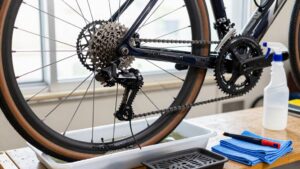
Consistent shifts depend on more than the system’s speed: correct setup and routine maintenance determine whether either drivetrain stays reliable. Electronic derailleurs repeat motor-controlled positions, but you must set their actuator limits correctly. On a mechanical system, adjust cable tension and indexing so each sprocket aligns cleanly.
For both systems, first verify that the derailleur hanger is straight and that cables, hardware, and mounting points are fully seated. A minor alignment error causes noise, skipping, or hesitant shifts, especially under load. Measure chain wear regularly and replace the chain before elongated links damage sprocket engagement and accelerate cassette wear.
If you fit an 11–34T cassette, confirm derailleur capacity and chain wrap; a longer-cage derailleur may be necessary to prevent strain and missed shifts throughout.
Cost, Battery, And Compatibility
Although electronic and mechanical drivetrains can use identical chainrings and cassette ratios, they differ in cost, power requirements, and upgrade compatibility. Electronic systems cost more, but they provide consistent indexing and shifts under load through powered derailleurs. You’ll need to charge battery and select derailleurs matched to the cassette’s speed and maximum sprocket; a 34T cog still requires capacity.
Mechanical systems use cable pull, avoid charging, but cable friction and adjustment affect shift quality.
For either system, cassette standards govern upgrades. Shimano and SRAM 10- and 11-speed cassettes commonly fit HG freehubs. Moving to 12-speed may require a wheel or freehub: Shimano uses Micro Spline, while SRAM uses XDR. Your 50/34 rings and 11–30 range may stay similar, but chains, cassette, and derailleurs must match.
Rear Derailleur Capacity Limits
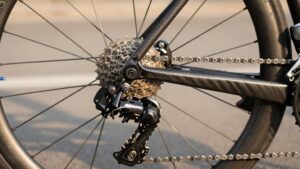
Before changing gearing, check your rear derailleur’s total capacity: cassette range plus the tooth difference between your chainrings. You must also stay within its maximum-cog rating, since an 11–34 cassette may require a longer-cage derailleur than an 11–28.
Confirm that your chainring sizes fit the derailleur’s stated capacity so it can maintain chain tension and shift reliably.
Understanding Total Capacity
Rear-derailleur capacity determines whether your drivetrain can handle a wider cassette without slack chain, poor tension, or unreliable shifting. Total capacity measures the chain-length difference the derailleur must absorb across all gear combinations. Calculate it by adding your chainring difference to your cassette difference: for a 50/34 crankset and 11 to 34 cassette, (50 − 34) + (34 − 11) = 39 teeth.
Compare that 39T requirement with the derailleur’s stated total-capacity rating, not merely its cage description. A short-cage unit may suit tighter road gearing, while a longer-cage model often provides more chain-wrap capacity for broad 2x ranges.
On a 1x drivetrain, chainring difference is zero, so capacity equals cassette spread. After changes, test all shifts; confirm tension in small-small and adequate clearance in big-big.
Maximum Cog Limits
Total capacity tells you how much chain slack the derailleur can manage; its maximum-cog rating tells you how large a cassette sprocket it can physically shift onto. Check both specifications before fitting a wider cassette. A cage that handles 11–32 may not clear or tension a 34T or 36T cog reliably.
| Largest cog | Practical requirement |
|---|---|
| 32T | Confirm stated rating |
| 34T | Often needs medium/long cage |
| 36T+ | Use rated long-cage derailleur |
Don’t treat freehub fit as approval. An oversized cog can leave the upper pulley too far from the teeth, producing hesitant shifts, skipping under load, or poor chain tension.
For steep routes, verify the maximum sprocket rating and total capacity together. That check confirms whether your 50/34 and 11–34 combination operates within specification, without adapters.
Chainring Size Compatibility
Although chainring size sets your highest and lowest ratios, derailleur capacity determines whether it can manage the chain slack created by your chainrings and cassette. Capacity is calculated by adding chainring tooth difference and cassette tooth range. Example: 50/34 rings add 16 teeth; 11 to 34 cassette adds 23 teeth.
Compare that result with the derailleur’s rated total capacity, then check its separate maximum-sprocket specification. A short-cage unit that works with an 11/28 cassette may not control chain tension with 50/34 rings and an 11/34 cassette. Select a medium- or long-cage derailleur when its specifications support the wider range.
Increasing your big chainring raises top gearing, but it doesn’t override those limits; the larger cassette still requires sufficient chain wrap and slack take-up. Verify full compatibility.
52/36 for Rolling Terrain
A 52/36 double suits rolling terrain because it preserves a fast 52T big ring for flats and descents while the 36T inner ring supplies a practical climbing gear when gradients rise. With an 11–28 cassette, your 52×28 ratio is 1.86, so the big ring remains usable on moderate inclines, while 36×28 delivers a 1.29 low gear.
Shift to the inner ring before cadence falls and use the cassette to fine-tune effort. On steeper rollers, an 11–32 lowers the minimum ratio to 1.13; an 11–34 adds further margin if needed. Target at least 75 rpm on your steepest regular climbs. If you can’t sustain it, choose the wider cassette or a smaller inner ring. This combination keeps your higher-speed gearing intact while adding useful climbing insurance.
11-Tooth Cogs Reduce Efficiency
An 11-tooth cog creates your hardest rear-gear option: with a 50/34 compact crank, 50×11 yields a 4.55 ratio, versus 4.17 for 50×12. That smaller sprocket raises distance per crank revolution but also demands more torque or cadence to sustain a given speed.
If the load pulls your cadence below your efficient range, you’ll often compensate with higher pedal force and less economical muscle recruitment.
A 12-tooth smallest cog lowers the top ratio and lets you spin more easily at the same road speed. Choose it if you rarely use 50×11 without bogging down. Keep the 11T when flat, fast routes and your sustainable power let you turn it at an effective cadence. It’s a useful top gear only when you can actually use it.
Cross-Chaining Wears Parts Faster
Cross-chaining occurs when you run the big chainring with the largest rear sprockets or the small chainring with the smallest ones. That extreme chain angle increases side loading, friction, and wear across the chain, cassette, and chainring.
Reduce it by choosing front-ring shifts before you reach the cassette extremes:
- Use the big ring mainly with smaller-to-middle sprockets.
- Use the small ring mainly with middle-to-larger sprockets.
- Don’t wait: shift early, keeping the chainline straighter and pedaling smoother.
On a 50/34 with an 11-32 or 11-34 cassette, middle cassette gears usually provide alignment. This preserves effective tooth engagement, reduces specific pressure, and slows chain wear. A worn chain then damages cassette teeth quickly, so avoiding repeated extreme pairings extends drivetrain life and keeps the drivetrain quieter.
Confirm Chain Length After Changes
Keeping the chainline sensible also depends on correct chain length after any cassette or chainring change. Start with the derailleur on the smallest rear cog and the chain on the smallest chainring, then add two full links as a baseline check. If you fit a larger range, such as 11-34T instead of 11-28T, reassess it: the derailleur must wrap more chain on the largest sprocket.
Then shift to the smallest front ring and largest rear cog, the critical slack check. A short chain can bind or impair shifting; a long one can sag and increase drop risk. With a 50/34T compact and 11-34T cassette, inspect cage position: it shouldn’t be fully stretched or sagging. Test every shift under load before riding on the road.
Conclusion
Your gearing works as a system: crank tooth counts, cassette range, derailleur capacity, chain length, and shift design must match. Use 50/34 with 11-34 for broad climbing versatility, 52/36 for faster rolling terrain, and tighter 12-30 ranges when speed matters.
Remember that 11-tooth cogs add drivetrain losses, while cross-chaining accelerates wear. Before changing parts, verify derailleur limits and reset chain length. That’ll keep shifting crisp, efficient, and reliable on every ride you tackle this season.