Smart Trainer vs Dumb Trainer: Which One Fits Your Budget?
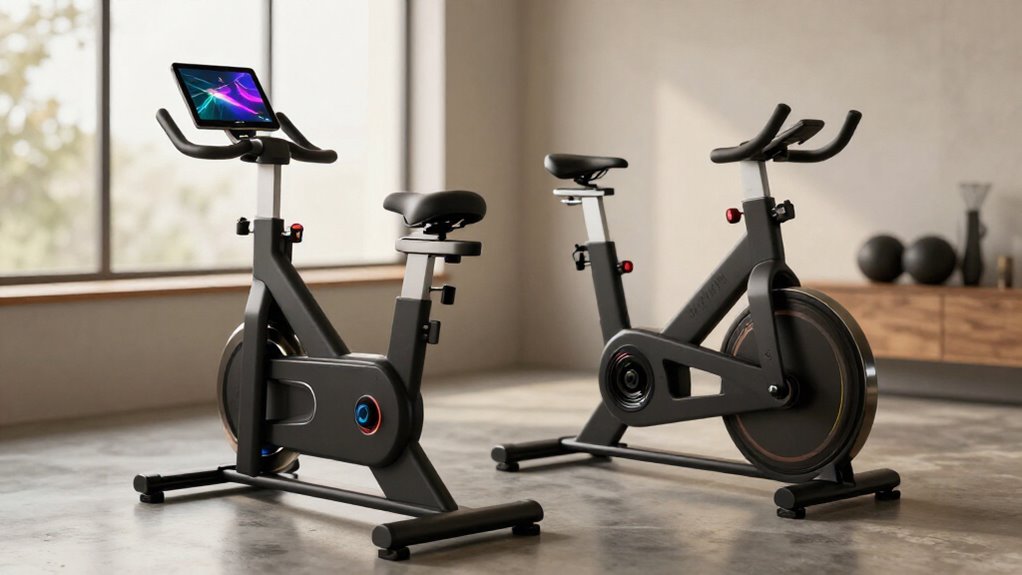
Choose a dumb wheel-on trainer if you need the lowest upfront cost, compact storage, and bike swapping; you’ll manage resistance and Zwift targets yourself, often with added sensors.
Choose a smart direct-drive trainer if you can spend more for accurate power, quieter operation, ERG-controlled workouts, and resale demand.
Factor in cassette or axle compatibility, firmware risks, tire wear, and app subscriptions.
The comparisons below help you match automation, space, and long-term costs to your training.
Zwift and ERG Mode Support
For Zwift workouts, a smart trainer gives you the clearest functional upgrade: it pairs as a controllable device and uses ERG mode to automatically adjust resistance until you’re producing the prescribed wattage.
| Setup | What you control |
|---|---|
| Smart, ERG | Trainer holds targets |
| Smart, SIM | You shift for grades |
| Dumb + meter | You pace targets |
| Budget result | Meter adds data, not control |
Choose a controllable trainer if you value repeatable intervals: it reduces missed targets and frees attention for cadence.
Zwift then changes resistance for climbs in SIM mode, while you shift normally. A dumb trainer and power meter can record credible watts and drive avatar speed, but you must manage every passage. It costs less initially, yet it doesn’t buy ERG, gradient response, or virtual-shifting support.
Direct-Drive Versus Wheel-On Mechanics
That control advantage also depends on how the trainer connects to your bike. Direct drive units replace the rear wheel and lock into the drivetrain. You avoid tire and roller wear, eliminate the friction interface, and generally reduce noise. The trade-off is compatibility: you’ll need a suitable cassette and must match your bike’s axle and drivetrain standards.
Wheel-on trainers clamp around the rear wheel, so you can start with fewer parts and swap bikes more easily. However, roller pressure and tire condition add maintenance, and a dedicated trainer tire may prevent rapid wear from heat. A Saris Fluid-type setup costs less upfront, but its resistance remains mechanical. An Elite Suito-style direct-drive smart trainer costs more, yet it removes consumables and installation variables over time.
Power Accuracy and Road Feel
Power accuracy separates a low-cost trainer setup from one you can trust for structured workouts. A direct-drive smart trainer supplies true power and cadence data, so your intervals track their targets. ERG mode automatically holds prescribed watts, while a dumb trainer leaves resistance fixed and makes you manage effort and gearing. Wheel-speed virtual power can look close for casual riding, but it’s notoriously inaccurate for testing or coaching.
Road feel also favors better direct-drive systems: you get smoother inertia and resistance that responds to virtual grades. A KICKR V6, for example, reaches 2,200W and simulates 20% gradients, whereas budget Van Rysel D100 tops out at 600W. Both can feel more convincing than bumpy wheel-on magnetic resistance. If money is tight, add a true power meter.
Bike Mounting and Setup Time
Mounting time shifts the value calculation: a wheel-on dumb trainer clamps to your rear wheel in minutes, making it the quickest option for occasional rides or tight storage. You secure the bike, set roller pressure, and ride, although a trainer tire limits heat wear. Budget models may need separate speed, cadence, or power sensors before apps show useful data.
A direct-drive smart trainer takes longer initially: you remove the rear wheel and mount the bike to its drivetrain interface. Once installed, it typically broadcasts power and cadence through ANT+ or Bluetooth, avoiding add-on sensor setup. Models such as the Elite Suito can simplify assembly with included parts. Pay more upfront, but you’ll get smoother operation, less tire wear, and consistent measurements for structured sessions.
Cassette, Axle, and Space Fit
Before you compare wattage limits or app features, confirm that the trainer fits your bike and home. A wheel-on dumb trainer clamps to your rear wheel, avoiding cassette purchases and most axle questions. Direct-drive smart trainers replace that wheel, so verify through-axle compatibility, dropout adapters, and cassette or Zwift Cog requirements before treating a low sticker price as a bargain.
- Check whether the trainer includes a Zwift Cog; Saris H3 may require a cassette.
- Match your bike’s through-axle standard and supplied adapters.
- Confirm shifting hardware works with the chosen Cog or cassette.
- Measure storage: a Wahoo Kickr V6 weighs 21.9 kg.
- Compare gearing needs: Victory reaches 1,800 W; H3 reaches 2,000 W.
Without it, you’ll use manual gears. Budget cassette and adapters upfront too.
Tire Wear and Replacement Costs
Tire wear is a recurring cost that can make a cheap wheel-on dumb trainer less economical over time: its roller heats and abrades the rear tire under load. Use a dedicated trainer tire rather than sacrificing your road tire, especially if you train indoors several times weekly.
Direct-drive smart trainers remove the rear wheel, so drivetrain resistance eliminates roller-to-tire contact and its replacement bill. Their higher purchase price can then offset recurring tire costs over time.
If you keep a wheel-on unit, check roller material: Saris Fluid’s PVC and Fluid2’s anodized aluminum rollers interact differently with tires. Matching the tire to the roller reduces wear and replacement hassle. Avoid assuming bundled speed sensors solve every issue; inaccurate readings can prompt troubleshooting and extra purchases.
Firmware Updates Can Fail
Unlike a dumb trainer’s largely mechanical setup, a smart trainer adds firmware and wireless connectivity as potential costs in reliability and time. An interrupted update can leave you without ERG control, so prescribed wattage arrives late, wrong, or not at all. Bluetooth dropouts and poor pairing can mimic a hardware fault, consuming troubleshooting time that a dumb trainer avoids.
Before training, you should:
- Charge phone, trainer, and host device first, and reboot once.
- Keep ANT+ available when Bluetooth pairing is unstable.
- Avoid updates immediately before an important workout.
- Protect WiFi updates from interrupted 2.4GHz connections.
- Check smoothing settings after each successful update.
Purchase Price and Resale Value
You’ll spend under $250 on many dumb trainers, while direct-drive smart models typically start near $500 and can exceed $1,300. Factor in sensors or a power meter for a dumb setup, versus possible cassette and app costs for a smart trainer.
Smart trainers often retain more resale value because buyers want integrated power, ERG control, and app compatibility.
Upfront Cost Differences
Price is the clearest dividing line: basic dumb or wheel-on trainers often cost under $250, while a wheel-on smart model can start around $300 and direct-drive smart trainers commonly run $500-$1,300 or more. That spread reflects hardware: direct-drive units integrate resistance control and power measurement, whereas a basic trainer supplies resistance only. Your real entry price depends on the data and automation you need.
- Dumb trainer: under $250 before any separate power-measurement hardware.
- Wheel-on smart: about $300 for app connectivity without direct-drive hardware.
- Mid-range direct drive: $500-$800, balancing accuracy, durability, and controlled resistance.
- Flagship models: $1,300-plus when you pay for premium features.
- Add a cassette if your direct-drive trainer doesn’t include one.
Factor in sensors, adapters, and app fees before setting your budget.
Resale Value Considerations
Purchase cost matters, but resale value can narrow the real gap between trainer types. A direct-drive smart trainer costs more initially, yet models such as the $1,299.99/£1,099 KICKR V6 typically retain more demand because buyers want Zwift, ERG, integrated power, and current connectivity. WiFi support and straightforward firmware updates can further protect its appeal.
A £259.99 Van Rysel D100 limits your exposure, but its 600W ceiling and narrower buyer pool may cap resale. A cheap dumb trainer can be economical, especially used, but buyers may discount it unless your included ANT+/Bluetooth sensors or power meter provide trusted data.
If you expect to upgrade, buy equipment you’ll keep: a dependable power meter first, then an ERG smart trainer later. This limits duplicate measurement spending over time.
Apartment Riders, Winter Training
In an apartment, you’ll need to weigh a direct-drive smart trainer’s lower noise and consistent ERG workouts against its $500-plus cost and larger footprint. A sub-$250 wheel-on dumb trainer stores more easily, but tire noise, vibration, and manual resistance changes can test your neighbors and winter-training consistency.
Budget for a mat, dedicated trainer tire, and quick setup routine whichever option you choose.
Noise Limits And Neighbors
For apartment riders, noise control often matters as much as upfront cost: a direct-drive trainer, smart or dumb, usually creates less tire and roller noise than a wheel-on model. That distinction can save you money: a sub-$250 dumb trainer may work, but a wheel-on unit sends tire contact, roller vibration, and hard-effort noise into floors and walls. A direct-drive option costs more, yet protects neighbor relations better.
- Prioritize direct drive before paying extra for smart controls.
- Compare published noise figures: Van Rysel D100 measures about 58dB.
- Saris H3 reviews cite roughly 61dB under comparable conditions.
- Expect louder responses when you sprint or sustain high power.
- Add vibration isolation beneath the trainer to reduce structure-borne sound transmission downward.
Winter Training Consistency
Quiet operation helps with apartment living, but winter consistency determines whether your trainer supports regular, measurable progress. A smart direct-drive trainer makes long winter sessions easier: ERG mode holds prescribed wattage instead of forcing you to manage gears and effort. JetBlack Victory supports up to 1,800W, while Wahoo KICKR V6 reaches 2,200W.
Interactive resistance also makes Zwift gradients feel more believable, which can sustain motivation. On a tighter budget, a wheel-on dumb trainer works with Zwift or TrainerRoad using cadence and speed sensors, but algorithmic virtual power is significantly inaccurate.
Add a real power meter for dependable outdoor structure before buying smarter indoor control. Then upgrade to an ERG-capable direct-drive unit when repeatable, power-by-watt winter workouts matter more than the lower upfront cost.
Space, Storage, And Setup
Apartment riders often get the simplest storage solution from a folding wheel-on dumb trainer such as the Saris Fluid2: it stores compactly, avoids cassette compatibility, and costs less than a direct-drive smart setup. For winter sessions, you’ll trade portability against noise, tire wear, and connection complexity. Choose based on how often you must clear your floor.
- Use a trainer tire; wheel-on rollers heat regular tires quickly indoors.
- Budget for sensors if you need Zwift power and cadence data.
- Pick direct drive for quieter operation and minimal rear-wheel wear.
- Plan clearance for wheel removal, a cassette, cables, and trainer weight.
- Check ANT+, Bluetooth, and stable power before committing to smart control.
A Tacx Flow Smart or Elite Suito saves setup time, but increases upfront cost.
Training App Subscription Costs
Subscription fees can reshape the value equation more than the trainer’s sticker price suggests. A smart trainer’s app-controlled resistance makes paid Zwift or TrainerRoad-style plans more useful: ERG mode holds your target wattage, while simulated terrain responds automatically. Its built-in power and cadence can also avoid extra sensor purchases.
A dumb setup can still join the same platforms with a power meter or speed-sensor virtual power, so subscription fees don’t disappear. But virtual watts are notoriously inaccurate, reducing the value of precision workouts and coaching. Include the recurring app charge in your total cost.
If you won’t use ERG or structured plans regularly, a sub-$250 dumb trainer plus your existing power meter may deliver better value despite the same fee for casual winter rides.
Conclusion
You’ll get the best value by matching trainer capability to your riding and space. Choose a dumb wheel-on trainer if you want the lowest upfront cost, simple storage, and occasional resistance work, but accept manual shifts, tire wear, and limited Zwift control.
Buy a smart direct-drive unit if you need accurate power, ERG workouts, quieter apartment use, and stronger resale. Budget for a cassette, adapters, firmware support, and app subscriptions before comparing final prices carefully.