Fat Bike Tire Pressure for Sand
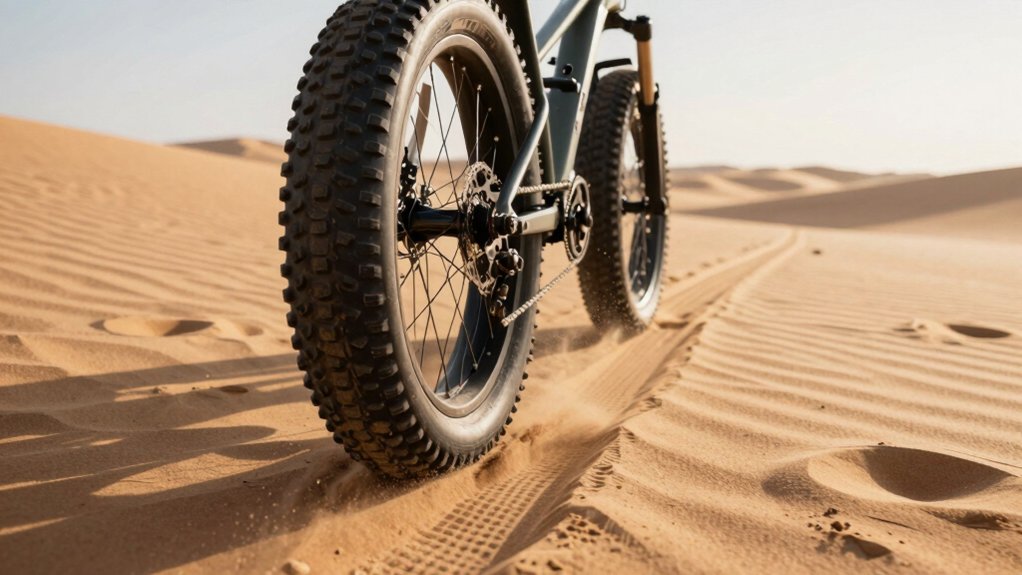
You should run very low pressures on sand to float and steer:
aim for about 4–7 PSI front and 6–8 PSI rear, adjusting ±1–2 PSI for rider weight, tire width, and sand firmness.
Use wider tires to go lower without rim strikes.
Test with short laps and tune with a reliable low‑PSI gauge and pump.
Watch for digging (raise pressure) or bouncing (lower pressure).
Keep pressure within tire and rim limits to avoid damage; more tips follow.
Quick Overview
- For soft or deep sand, aim for 4–7 PSI front and 6–8 PSI rear for flotation and traction.
- On loose dry sand, start with ~6 PSI front and ~8 PSI rear; adjust ±1–2 PSI by feel.
- Packed or firm sand needs higher pressures (8–12 PSI) to prevent bogging and rim strikes.
- Use a reliable low-PSI gauge and a high-volume pump to tune on the fly in small increments.
- Ride a short test loop and adjust 1–2 PSI based on digging, bouncing, or steering feedback.
Quick PSI Recommendations for Sand
Typically, start with 6 PSI front and 8 PSI rear on dry loose sand to balance flotation and steering; you’ll adjust from there based on rider weight, tire width, and sand softness. Lower pressures increase contact area and traction but raise rolling resistance and rim-risk; don’t go below what your rims and tires tolerate.
Use a reliable gauge and a wide-barrel pump to fine-tune pressures on the fly. This is practical myth busting: common gear rumors that “lower is always better” ignore handling and rim protection. Aim for progressive adjustments—small drops for softer sections, slight increases for firmer patches—and monitor how the bike tracks and corners. Document settings for repeatable results.
Exact PSI Targets by Sand Type (Soft Dunes, Dry Loose, Packed)
How low should you set your pressures for different sand types? For soft dunes, aim for 4–7 PSI: Start near 6 PSI and drop toward 4 PSI if you’re light or want maximum flotation. Monitor sand temperature; hot sand lowers effective stiffness, and increase slightly if rims feel unstable.
For dry loose sand, run 6 PSI front and 8 PSI rear as a baseline. Adjust ±1–2 PSI based on rider weight and soil moisture; drier sand may need a touch more pressure.
For packed sand, use 8–12 PSI to preserve handling and avoid sluggish steering. Heavier riders trend higher in that range. Use precise gauges, wide-barrel pumps, and small increments when dialing in pressure on warm or varying moisture conditions.
Why Low PSI Helps Sand Riding
Having picked a starting pressure for the sand you’re riding, you want to understand why lowering PSI actually improves performance. Lowering PSI increases the tire’s contact patch; so load spreads over more sand and reduces sinkage: that’s basic flotation physics at work. Greater contact area lowers ground pressure, improving traction and steering control without digging in.
A softer tire also deforms to absorb small undulations, smoothing ride forces and maintaining wheel speed across loose surfaces. You must balance this with bead seating: keep enough pressure to firmly locate the bead on the rim to avoid burping or unseating during side loads. In practice, you drop PSI until flotation and control improve. Then stop before handling degrades or bead seating becomes marginal.
How Rider Weight and Tire Width Change Your PSI
Why does your weight matter when you pick PSI for sand? Your mass determines sinkage and contact patch. Higher weight increases weight impact; therefore, you must run higher PSI to prevent excessive rim strikes and sidewall roll. Balance flotation with rim protection: Heavier riders add 2–5 PSI versus a lighter rider on the same tire.
Width effects are equally critical. Wider tires (4.6–4.8″) provide greater volume, letting you run lower PSI for the same load without bottoming out. Narrower fat tires demand higher pressures to maintain structural support. Use a simple rule: Increase pressure with rider weight; decrease pressure with greater tire width. Adjust in small increments (1–2 PSI) and test. Monitor handling and rim clearance rather than aiming for a fixed number.
Front vs Rear PSI for Sand Riding
Wondering how to split pressure between front and rear when riding sand? You’ll typically run a slight front bias to improve steering float and a rear bias for traction under power. Use lower pressures overall; however, keep the rear a touch higher to prevent bogging and rim strikes.
- Front bias: Drop front PSI 1–3 psi below rear to widen contact patch for steering and flotation without sacrificing control.
- Rear bias: Keep rear 1–3 psi higher to maintain drive traction, prevent squirm, and reduce risk of rim strikes under load.
- Adjustment: Increase or decrease both sides together based on rider weight and sand softness; keep differences small and test short runs to refine.
Balance front bias and rear bias for predictable handling.
Step‑by‑Step: Set Your Pressure Before a Sand Ride
Before you head out, set your tire pressure based on sand softness, your weight, and tire width so you get flotation without rim damage. Start your setup routine by inspecting tires, rims, and valve cores. Remove debris, confirm core tightness, and check for cuts.
Decide target PSI: soft, deep sand 4–7 PSI; loose dry sand 6–8 PSI; firmer packed areas 10–12 PSI. Adjust the rear slightly higher. Use gradual deflation: release air in small increments, re-seat the bead if needed, and compress the tire with your hand to estimate float.
Ride a short test loop to verify handling. Increase or decrease 1–2 PSI based on dig-in or bouncing. Finish by securing valve caps and re-checking cores before full-speed sections.
Best Pumps and Tools for Accurate Low PSI
After you’ve settled on a target PSI and tested handling, the right pump and tools make hitting and holding low pressures repeatable and safe. You’ll want a high-volume pump with a wide barrel for quick, low-PSI fills and a head that seals Presta valves without leaking.
Use precision gauges to verify readings; built-in gauges on high-volume pumps can be inaccurate at very low PSI. Carry a small handheld gauge for spot checks and a shock pump for fine tuning. Tire balancers help you locate and correct heavy spots that amplify rim strikes at low pressure.
- High-volume floor pump + accurate head
- Handheld precision gauge + shock pump
- Tire balancers and rim tape inspection tools
What Handling Signs Mean (Too Low vs Too High PSI)
How does your bike tell you it’s sitting at the wrong PSI? You’ll read handling cues immediately: sluggish steering, mushy feel, or excessive squirm in corners indicate too low pressure. Low PSI pressure indicators include a flattened contact patch, increased rolling resistance, and slow rebound after compressions.
Conversely, you’ll notice harsh impacts, skittering over small bumps, and reduced traction when PSI is too high. High PSI pressure indicators are a smaller contact patch and bouncing over irregular sand, which reduces grip. Use these handling cues to iteratively adjust: lower front pressure for better float and steering; raise rear for stability and puncture resistance.
Monitor sensation changes and recheck with a reliable gauge to match PSI to sand conditions and rider weight.
Risks of Going Too Low and How to Protect Your Rims
If you run your fat bike tires too low on sand, you’ll increase the chance of rim strikes, pinch flats, and sluggish handling because the tire can’t support impacts or maintain proper bead seating. You’ll also risk rim damage from repeated impacts and sidewall folding. Low pressure lets the tire compress against the rim on sharp obstacles, transferring loads directly to the rim and tube.
- Monitor PSI: Keep within the sand-recommended band to balance flotation and rim protection.
- Use inserts or liners: They prevent rim contact during hard impacts and reduce pinch flats.
- Check bead seating and run slightly higher rear pressure than front to stabilize the wheel.
Inspect rims after rides and carry basic repair tools to address pinch flats or bent rims.
Quick PSI Tweaks for Wind, Surf, and Long Rides
Protecting rims on soft sand means you also need to tweak PSI proactively for conditions like strong wind, surf-packed shorelines, and long rides to keep handling predictable and energy use efficient. You’ll lower front pressure slightly into the 6–8 PSI range to increase flotation and maintain steering authority when wind resistance shifts your balance.
On surf-packed sand, raise both tires toward 8–10 PSI to reduce drag from sticky wet sand and avoid tire squirm as seasonal tides firm the surface. For long rides, prioritize efficiency: increase rear pressure 1–3 PSI above your sand baseline to limit rolling resistance while keeping front pressure lower for comfort and control.
Check pressures often, carry a wide-barrel pump, and adjust incrementally based on feel.
Frequently Asked Questions
You’ll find answers here on best PSI ranges for different sand types, plus quick tips for adjusting pressure on the fly.
We’ll cover how tire width changes those numbers and which riding techniques let you run lower or higher pressure safely. Use these FAQs to match pressure to sand, weight, and handling without guessing.
Optimal Pressure Range
Wondering what tire pressure you should run in sand? You’ll target a narrow ideal pressure range based on tire width, weight, and sand softness. Use range optimization: lower for soft, higher for firmer sand, always preserving tire flotation without rim strikes.
- Soft/deep sand: 4–7 PSI front, 6–8 PSI rear for maximum tire flotation and traction.
- Loose dry sand: 6–10 PSI, balancing flotation with control; heavier riders add ~1–2 PSI.
- Firmer packed sand: 10–12 PSI to reduce rolling resistance while retaining grip.
Measure pressure before each ride. Consult manufacturer limits, and avoid extremes that cause rim damage or excessive bounce. These ranges give a technical starting point; adjust minimally within them.
Pressure Adjustment Tips
How should you tweak tire pressure on the fly for sand? You’ll drop or raise PSI based on sand firmness, rider weight, and handling feedback. Use a high-volume pump or shock-style inflator to make rapid, accurate changes. Carry a gauge rated for low PSI.
Check valve types: Presta is common, but Schrader adapters help with beachside pumps. For soft, loose sand, start around 6–8 PSI front, 8–10 PSI rear. For very soft, go toward 4–6 PSI, but avoid extreme lows that risk rim strikes.
Watch handling: excessive squirm means add 1–2 PSI; bouncing means add more. Inspect tread wear regularly. Low pressures accelerate center tread wear and can hide cuts. Reinflate to recommended pressures for hard-packed or paved exits.
Tire Width Effects
After you’ve practiced on the sand and learned how pressure adjustments affect handling, tire width becomes one of the next key variables to manage. You’ll notice width impact immediately: wider tires increase air volume, so you can run lower PSI without rim strikes. This improves flotation performance on soft sand. Wider sections spread load, reduce sinkage, and stabilize steering, but they change rolling resistance and cornering feedback.
- Wider (4.6–4.8″): allows 4–7 PSI for max flotation performance; watch for slower steering.
- Mid (4.0–4.5″): balances flotation and control; target 6–10 PSI depending on rider weight.
- Narrower fat variants: need higher PSI to avoid rim strikes; sacrifice some flotation.
Adjust within these ranges. Calibrate by feel and monitor rim protection.
Riding Technique Impacts
Because your technique changes how the bike interacts with soft sand, small adjustments to body position, braking, and cadence can let you run lower pressures without risking rim strikes or loss of control. Shift weight rearward on climbs and slightly forward on flats to keep the contact patch even; this reduces digging and lets you use 6–8 PSI more confidently.
Modulate brakes early and gently. Hard front braking bites and collapses the tire. Maintain a higher, steady pedal cadence to smooth power delivery and prevent sudden torque that digs the tire in; consistent cadence preserves momentum.
For turns, widen your line, lean the bike less, and prioritize cornering grip by lowering speed and increasing trail radius. Practice these inputs on firm sand before committing to deep soft sections.
Conclusion
For sand you’ll ride lower than on hardpack; generally 2–6 PSI depending on tire width and sand type. Go near the low end on soft, dry dunes and a bit higher on packed or wet sand.
Lower pressure boosts flotation and traction. Heavier riders or narrow tires need more PSI. Keep the front slightly softer than the rear for steering. Watch for rim strikes and burping; use inserts or run tubes with sealant if you dip below safe limits.